Publications and Articles
Motivation and Inflation: Why Compensation Strategy Matters in Volatile Economies
In today’s volatile macroeconomic environment, organizations face a dual challenge: maintaining financial stability while preserving employee motivation. Understanding the linkage between compensation dynamics and workforce engagement is not just an HR concern—it is a fundamental component of sustainable business strategy.
The Core Question
A common question asked by executives is: “How should employees be financially motivated to ensure task fulfillment and long-term loyalty? What level of salary adjustment should a company provide?”
The essential principle is straightforward: compensation adjustments must reflect the financial reality of the company, but base salary should never be eroded in real terms.
Inflation as a Baseline for Retention
A scientifically grounded compensation model should treat the official inflation rate as the minimum threshold for annual salary adjustments. Anything below this level effectively constitutes a reduction in real earnings.
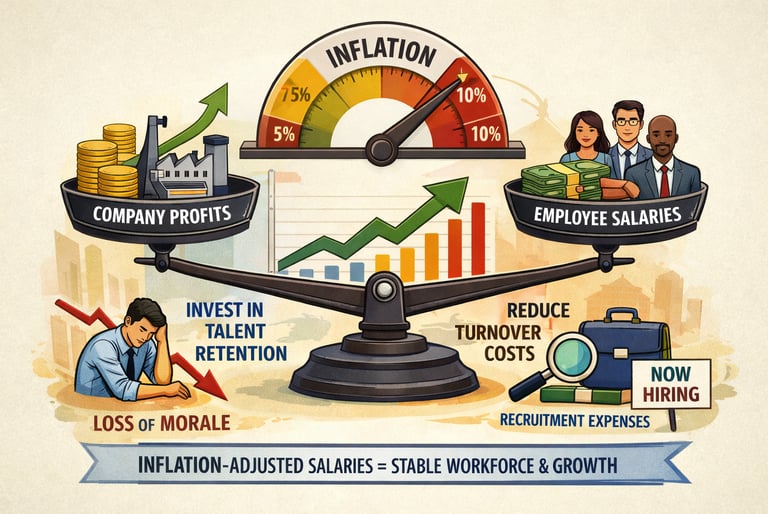
In many high-inflation or high-volatility economies, businesses tend to apply nominal, standardized increases—5%, for example—regardless of the actual inflation rate. In practice, this creates a negative motivational spiral:
Employees realize that their purchasing power has declined compared to the previous year.
They anticipate further declines in future years.
High-performing talent becomes more susceptible to external offers that reflect current market realities, not the outdated salary base from several years prior.
Organizations subsequently incur higher costs for recruitment, onboarding, and productivity ramp-up than they would have incurred by simply offering inflation-indexed adjustments.
This is a classic case of short-term cost avoidance resulting in long-term value destruction.
Economic Rationale: The Cost of Turnover vs. the Cost of Adjustment
Employee turnover carries tangible and measurable costs: recruiting, onboarding, training, and temporary productivity loss. When added together, these expenses frequently exceed the incremental cost of offering inflation-aligned salary increases.
Thus, from a business-economic perspective, salary adjustments are not a cost—they are an investment in capability retention and organizational stability.
If a company expects its customers to absorb annual price increases of 15–20% due to inflation, there is a clear inconsistency in refusing to apply at least inflation-level adjustments to employee compensation. A marginal difference (e.g., 2% above inflation) allocated to personnel costs is often negligible relative to the strategic value of talent retention.
Managerial Guidance
If leadership assigns cost-saving KPIs to managers, it is prudent to exclude personnel costs and product quality from the optimization scope. Pressuring managers to reduce headcount or suppress compensation typically leads to underperformance, operational degradation, and morale collapse.
If managers fail to identify alternative efficiency measures, this should be treated as a performance issue—not a justification for degrading human capital.
Strategic Takeaway
In uncertain times, effective leaders balance financial discipline with human-centric strategy. Integrating inflation-indexed compensation into annual planning is not only feasible—it is operationally efficient. Businesses that maintain competitive and fair compensation frameworks consistently outperform those that rely on austerity measures and tolerate high turnover.
Motivation and Inflation