The critical role of local teams when starting a new factory in developing production cultures
Why saving on the local team during a factory launch is one of the most expensive decisions a company can make.
Read article‹ All insights · People & strategy
Salary adjustments below inflation are a pay cut — and a costly one.
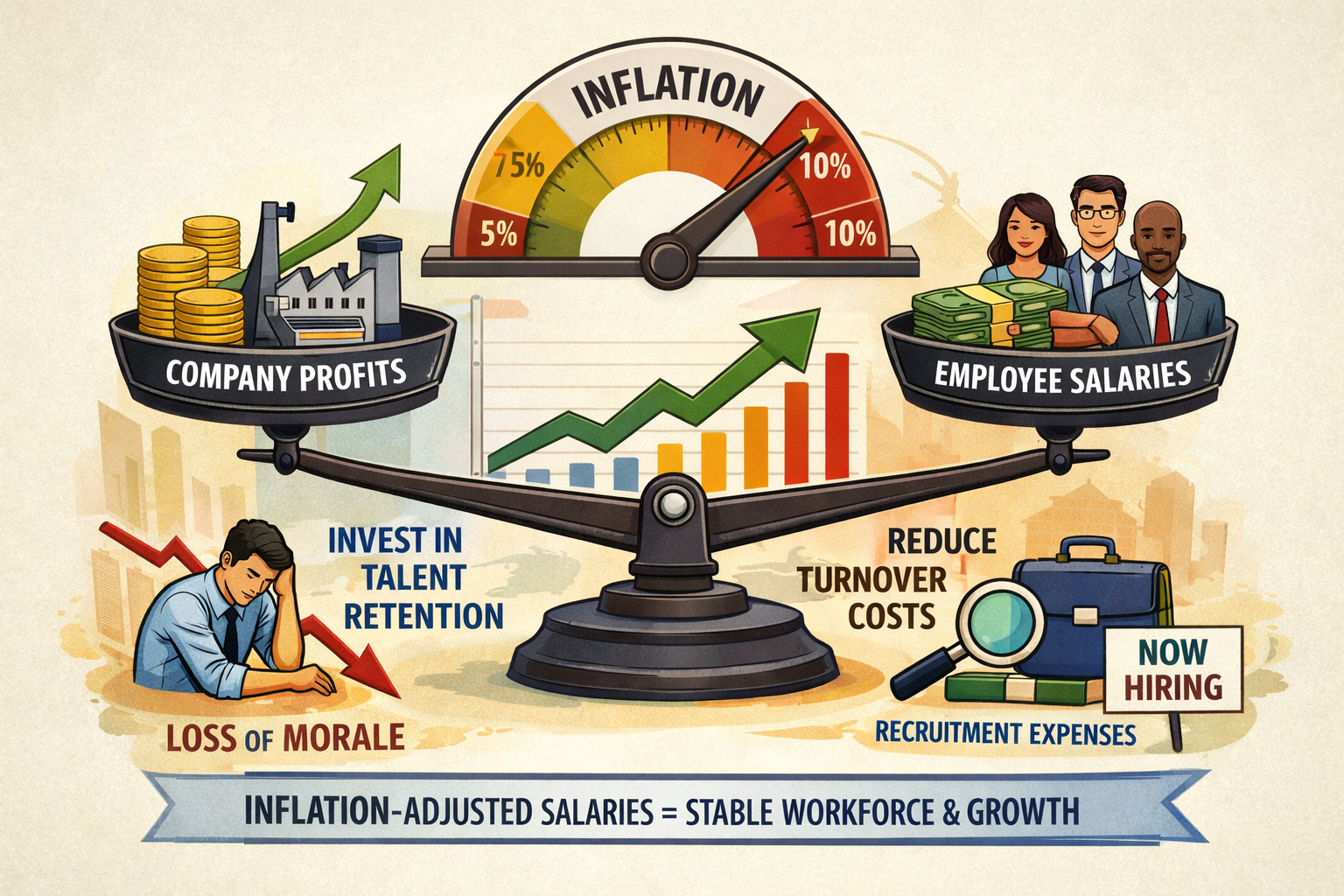
In today’s volatile macroeconomic environment, organisations face a dual challenge: maintaining financial stability while preserving employee motivation. The link between compensation dynamics and workforce engagement is not just an HR concern — it is a fundamental part of sustainable business strategy.
Executives often ask: how should employees be financially motivated to ensure task fulfilment and long-term loyalty, and what level of salary adjustment should the company provide?
The principle is straightforward: compensation adjustments must reflect the company’s financial reality, but base salary should never be eroded in real terms.
A sound compensation model treats the official inflation rate as the minimum threshold for annual salary adjustments. Anything below it is effectively a reduction in real earnings.
In many high-inflation economies, businesses apply nominal, standard increases — say 5% — regardless of actual inflation. In practice this creates a negative motivational spiral:
A classic case of short-term cost avoidance resulting in long-term value destruction.
Turnover carries measurable costs: recruiting, onboarding, training and temporary productivity loss. Added together they frequently exceed the incremental cost of inflation-aligned increases. From a business-economics perspective, salary adjustments are not a cost — they are an investment in capability retention and organisational stability.
If a company expects customers to absorb annual price increases of 15–20% due to inflation, it is inconsistent to refuse at least inflation-level adjustments to its own employees. A marginal difference — e.g. 2% above inflation — is usually negligible next to the strategic value of retaining talent.
If leadership assigns cost-saving KPIs to managers, it is prudent to exclude personnel costs and product quality from the optimisation scope. Pressure to cut headcount or suppress pay typically leads to underperformance, operational degradation and collapsing morale. If managers cannot find other efficiency measures, that is a performance issue — not a justification for degrading human capital.
In uncertain times effective leaders balance financial discipline with a human-centric strategy. Building inflation-indexed compensation into annual planning is not only feasible — it is operationally efficient. Companies with competitive, fair compensation consistently outperform those that rely on austerity and tolerate high turnover.

Why saving on the local team during a factory launch is one of the most expensive decisions a company can make.
Read article
The cheapest equipment on the tender sheet is often the most expensive one on the balance sheet.
Read article
SMART is not enough. Add Process and Person — and KPIs start managing for you.
Read article